
- Share
- Share on Facebook
- Share on LinkedIn
Soutenance
On 17 December 2026
Grenoble - Presqu'île
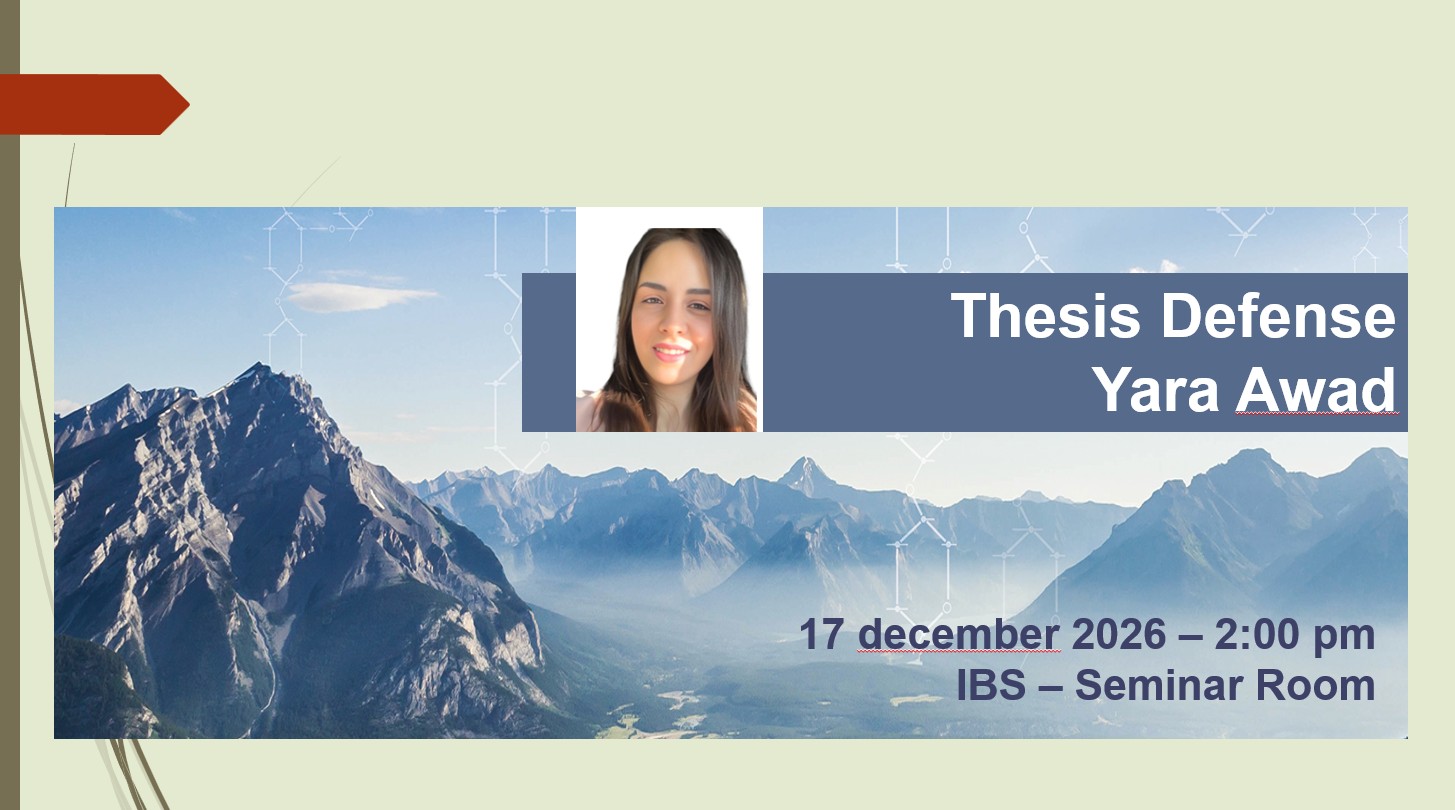
Yara Awad will defend her doctoral thesis, entitled "Novel Bacterial Sulfatases Targeting Glycosaminoglycans: From Identification to Application" on Thursday December 17, 2026, 2:00 pm, Conference room, IBS, Grenoble
Yara Awad will present her research work that has been performed at IBS under the direction of Romain Vivès.
Glycosaminoglycans (GAGs) are complex, linear, highly negatively charged polysaccharides. GAGs play essential roles in numerous pathophysiological processes by binding and modulating the activity of a myriad of proteins through interactions involving saccharide motifs of specific sulfation patterns. Sulfatases play an essential function in GAG turnover, but increasing evidence also point out roles in modulating their sulfation patterns and therefore biological activities. Only a limited number of sulfatases acting on GAGs have been identified and characterized to date. Their catalytic activity relies on the presence of a conserved formylglycine (FGly) residue, which is essential for the hydrolysis of sulfate groups. GAG sulfatases can be classified according to their mode of action into exo-acting and endo-acting enzymes. Exo-sulfatases act on sulfate groups located at the extremities of GAG oligosaccharides and therefore rely on prior degradation of the polysaccharide by lyases. In contrast, endosulfatases are able to act within the intact polysaccharide chain. There are several significant challenges to overcome in the study of sulfatases. The first is the tremendous diversity of sulfated substrates, which complicates the precise characterization of enzyme activities. As such, prediction of substrate preference and mode of action based on sequence homology remains limited and poorly reliable. Another challenge is the expression of functional recombinant enzymes. Heterologous expression of sulfatases in E. coli can be readily achieved. However, generation of the catalytic FGly residue depends upon the formylglycine-generating enzyme (FGE) machinery, which differs among species.
In this thesis, we have identified and characterized SoS1_27, a novel bacterial CS 4-O-endosulfatase from Segatella oris, a bacterium of the oral cavity human microbiota. SoS1_27 was expressed in E. coli BL21(DE3), and activity assays confirmed that the enzyme specifically removes 4-O-sulfation from both chondroitin/dermatan sulfate disaccharides and polysaccharides. Enzyme kinetics were determined, as well as optimal pH and temperature for enzyme activity. Using X-ray crystallography, we determined its structure at 2.4 Å resolution. The structure reveals that SoS1_27 adopts an α/β fold typically found in S1 sulfatases, with a two-domain architecture. It also illustrates the spatial arrangement of the active site, featuring Ser84 (OSE84) and the coordinated Mg²⁺ ion. We also studied the biological properties of SoS1_27 and explored its ability to promote neuronal migration in vitro, and in an in vivo model of rat spinal cord injury.
In parallel, we developed a tool enabling reliable detection of the FGly maturation in sulfatases, enabling rapid assessment of the functional integrity of sulfatases recombinantly expressed in heterologous systems. We demonstrate that this technique is quantitative and can be used to assess FGly modification on both purified protein and crude cell extracts. Finally, the technique enabled us to identify two novel HS 2-O-exosulfatases from the soil bacteria Pseudopedobacter saltans,
In conclusion, this work provides a new tool for studying sulfatases, which will contribute to facilitate the study of these complex enzymes. It sheds light on new GAG-targeting sulfatases including the novel CS 4-O-endosulfatase SoS1_27. This enzyme exhibits promising neuron migration promoting activities, highlighting further the relevance of investigating sulfatases, both as valuable tools for GAG structural characterization and for potential therapeutic applications.
Date
2:00 pm
Localisation
Grenoble - Presqu'île
Conference room
IBS
- Share
- Share on Facebook
- Share on LinkedIn